Human trafficking cases are among the most aggressively prosecuted crimes in Nevada and federal courts. When someone is accused of trafficking, emotions run high, assumptions are made quickly, and the consequences can be extraordinarily severe — often involving lengthy prison sentences and significant social stigma long before a conviction occurs.
Many people do not realize that “trafficking” encompasses a wide range of conduct and that accusations can arise from misunderstandings, misstatements, or the actions of others.
Two major categories of trafficking charges dominate these cases: sex trafficking and labor trafficking.
While both involve allegations of exploitation, they are legally distinct and require prosecutors to prove very different elements. Understanding these distinctions is essential for anyone facing investigation or charges because the defense strategy must address the specific legal requirements of the accusation.
The Law Office of Joel M. Mann represents individuals accused of serious trafficking offenses in Nevada. Joel approaches these cases with urgency, precision, and a commitment to ensuring that the state proves every element beyond a reasonable doubt. Accusations alone are not evidence — and every detail matters.
Reach out to a Las Vegas criminal defense lawyer at the Law Office of Joel M. Mann today for immediate, strategic representation if you’re facing sex or labor trafficking allegations in Nevada.
Key Takeaways:
- Sex trafficking and labor trafficking are separate offenses with different legal elements.
- Both can be charged at the state or federal level, depending on the circumstances.
- Accusations often rely on complex investigations, witness statements, and electronic evidence.
- The Law Office of Joel M. Mann builds detailed, fact-driven defenses tailored to the specific type of trafficking alleged.
- Early representation is critical to avoid missteps and protect your rights.
Understanding Sex Trafficking Allegations
Sex trafficking accusations generally involve allegations that someone induced, coerced, transported, or benefited from another person engaging in commercial sexual activity. In Nevada, prosecutors may charge sex trafficking even when money is not exchanged directly, when no physical force is alleged, or when both parties dispute what actually occurred.
These cases often rely on digital evidence such as messages, online ads, financial transfers, or travel arrangements. Statements from alleged victims can also play a central role, though such statements are sometimes inconsistent or influenced by outside pressures.
When minors are involved, the accusations become even more severe because prosecutors do not need to prove force or coercion — the law automatically treats certain conduct as trafficking.
Joel’s defense work in sex trafficking cases focuses on the specifics of the relationship between the parties, the accuracy of the state’s timeline, and whether police or investigators made assumptions that are not supported by evidence.
He also examines whether the alleged conduct truly meets the statutory definition of trafficking or whether the state is stretching the facts to fit a charge that does not apply.
Understanding Labor Trafficking Allegations
Labor trafficking accusations involve claims that someone forced, coerced, or manipulated another person to work against their will.
These cases may involve allegations of withholding identification, restricting movement, threatening immigration consequences, or creating unsafe or unfair working conditions. However, not every workplace dispute or unfair employment practice constitutes trafficking.
Labor trafficking cases can arise in environments such as construction, domestic work, hospitality, or small businesses. Sometimes the accused is an employer, manager, or someone who oversaw certain aspects of work. In other situations, accusations stem from personal disputes, misunderstandings about job responsibilities, or disagreements about pay or working conditions.
Because labor trafficking allegations often involve immigration issues, investigators may rely heavily on statements made by individuals seeking visas or other immigration protections. These individuals may have incentives to portray events in a certain way. Joel evaluates all testimony carefully to determine whether the evidence supports the trafficking allegations or whether the situation reflects a different type of disagreement.
Understanding what legally qualifies as “force,” “coercion,” or “fraud” is essential. Prosecutors must prove specific actions, not just general claims of unfairness.
How Trafficking Investigations Begin
Trafficking investigations often start long before the accused becomes aware of them. Police may be alerted by online activity, financial patterns, hotline reports, immigration inquiries, or statements from third parties. In some cases, federal agencies like Homeland Security Investigations (HSI) or the FBI may become involved, bringing additional layers of complexity.
During an investigation, law enforcement may conduct surveillance, review digital communications, subpoena financial records, or interview people connected to the accused. Investigators may assume a trafficking narrative and interpret all information through that lens, even when the facts point elsewhere. This can create an expectation of guilt that shapes the entire case.
Joel works quickly to understand the scope of the investigation, identify what evidence law enforcement may be seeking, and ensure his clients do not inadvertently incriminate themselves.
Without legal guidance, individuals may provide statements, consent to searches, or turn over information that investigators later use against them. Prompt representation helps preserve rights and prevent the case from spiraling before the defense has a chance to intervene.
Why Trafficking Accusations Are Legally Complex
Both sex and labor trafficking cases require prosecutors to prove specific intent, which is often difficult to establish. Intent cannot be assumed — it must be demonstrated through clear evidence. Many trafficking accusations rely on interpretations of conversations, actions, or relationships that may not reflect the reality of what occurred.
In addition, trafficking cases often intersect with other allegations such as kidnapping, battery, prostitution, or immigration violations. These overlapping issues create opportunities to challenge the state’s theory of the case. Joel analyzes each layer of the allegations to determine whether investigators misunderstood the situation or misapplied the law.
Finally, trafficking cases frequently involve witnesses who may have motives to exaggerate, misunderstand, or alter their narratives. Some may be under personal, financial, or immigration pressure. Social stigma also plays a role, sometimes influencing how allegations are viewed even before evidence is presented.
Because of the complexity, clients need an attorney who understands how prosecutors build these cases and how to dismantle flawed assumptions.
Common Misunderstandings That Lead to Trafficking Allegations
Trafficking accusations sometimes arise from complex personal situations rather than intentional criminal conduct. In sex trafficking cases, misunderstandings may develop around financial support, living arrangements, shared travel plans, or communication that appears transactional when taken out of context.
Something as simple as paying for transportation, helping someone find work, or offering a temporary place to stay can be misinterpreted — especially when outside parties make assumptions.
With labor trafficking, disputes about wages, job duties, schedules, or immigration concerns may escalate into allegations that someone was forced or coerced.
Workers may misunderstand workplace policies, believe promises were broken, or feel pressure from third parties advising them to characterize the situation as trafficking. Immigration incentives — such as access to special visas for trafficking victims — can also influence how a situation is reported.
Nevada and federal law both require specific actions to meet the definition of trafficking.
Coercion, force, fraud, or exploitation cannot simply be assumed. Joel focuses on identifying whether the behavior described by investigators or witnesses legally qualifies as trafficking or whether it reflects misunderstandings, workplace disagreements, or personal conflict. These distinctions often form the core of the defense.
Differences in Penalties Between Sex and Labor Trafficking
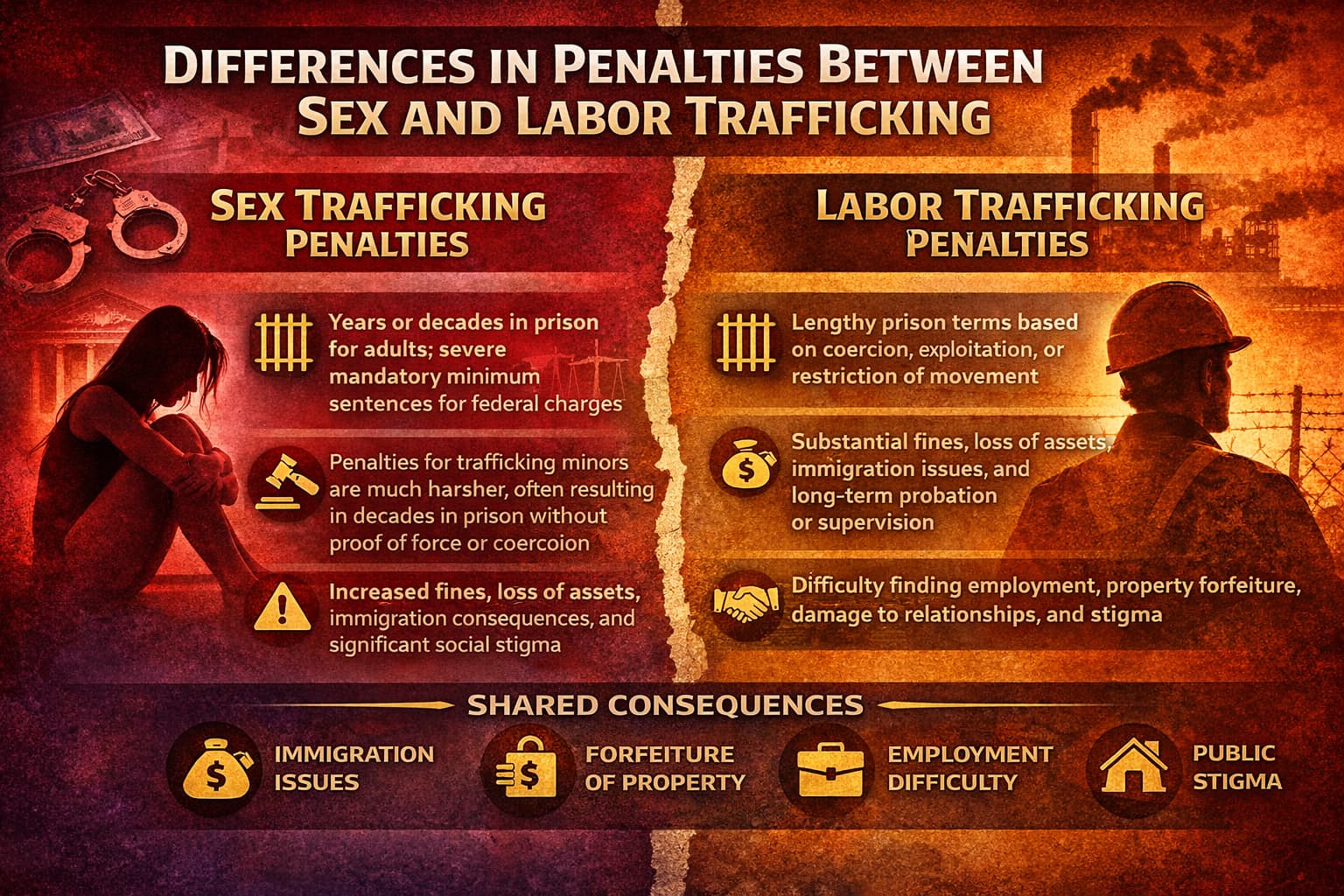
Although both sex and labor trafficking carry severe penalties, the consequences differ significantly depending on the nature of the allegation, whether minors are involved, and whether the case is prosecuted at the state or federal level.
Sex trafficking of adults may result in years or decades in prison, depending on the conduct and any alleged use of force or coercion. When minors are involved, penalties escalate dramatically, and prosecutors do not need to prove force — the law presumes exploitation. Federal charges carry especially severe mandatory minimum sentences.
Labor trafficking penalties also vary but generally focus on allegations of coercion, restriction of movement, or exploitation. While the sentences for labor trafficking of adults may be lower than sex trafficking involving minors, they still involve lengthy incarceration, significant fines, and long-term probation or supervision.
Both types of trafficking allegations can also lead to collateral consequences. These include immigration consequences, forfeiture of property, difficulty securing employment, damage to personal relationships, and overwhelming public stigma.
Joel works to identify weak points in the state’s theory early so that clients understand what they are facing and what strategies may lessen or eliminate the most severe penalties.
How Prosecutors Build Trafficking Cases
Understanding how prosecutors construct trafficking cases helps clarify why early legal defense is essential. Prosecutors typically rely on a combination of digital evidence, financial records, witness statements, surveillance, and expert testimony. They may use text messages, social media posts, transaction histories, ride-share records, and travel data to create a narrative of exploitation.
Prosecutors also often work closely with specialized law enforcement units and federal agencies, which can give them access to significant resources. Their strategy may involve presenting a pattern of behavior even when individual pieces of evidence are weak. This means that small details can be interpreted in ways that portray intent or coercion when the reality was far more complicated.
Joel evaluates every piece of evidence with precision. He considers how it was obtained, whether it is reliable, and whether it has been interpreted correctly. He also examines whether law enforcement overstepped constitutional boundaries in collecting information.
Weaknesses in the prosecutor’s timeline, inconsistencies in witness testimony, and gaps in investigative procedures can become powerful tools in a strong defense.
By understanding the prosecution’s approach, Joel can anticipate arguments, identify flaws, and build a defense that responds strategically rather than reactively.
How Defense Attorneys Challenge Trafficking Allegations
Defending trafficking cases requires a multi-layered strategy. Joel begins by examining the specific elements of the charge to determine whether each legal requirement can actually be proven. Many cases hinge on demonstrating coercion, force, or exploitation — concepts that prosecutors interpret broadly but must prove precisely.
Joel may challenge the credibility of key witnesses, especially when statements shift over time or when outside factors influence how they describe events. This can include revealing inconsistencies, questioning motivations, or highlighting situations where memory or perception may be unreliable.
Digital evidence also plays a major role in modern trafficking cases. Joel works to show how messages or online interactions may be misinterpreted, taken out of context, or selectively presented. He examines whether law enforcement obtained digital evidence properly and whether anything was altered or misrepresented.
Finally, Joel evaluates whether other charges, such as escorting-related offenses or labor disputes, have been incorrectly elevated into trafficking allegations. This is a common issue when investigators assume exploitation without having evidence to support the legal definition. A strong defense often requires demonstrating that the prosecution’s version of events is not consistent with actual facts or the law.
The Importance of Early Representation in Trafficking Cases
Trafficking cases often move quickly, especially when federal agencies are involved. Investigators may conduct interviews, seize property, or request warrants before the accused realizes the scope of the investigation. Early representation prevents costly mistakes, such as unintentionally providing information that supports the prosecution’s theory.
Joel steps in immediately to direct communication with law enforcement, advise on search and seizure issues, and protect against self-incrimination. He also begins gathering favorable evidence immediately — something that becomes harder as time passes and memories fade.
In trafficking cases, early strategy can change the entire trajectory. Whether the goal is dismissal, reduced charges, or preparing for trial, success depends on taking control before prosecutors define the narrative. Joel ensures clients understand the stakes, the process, and the best steps to safeguard their rights and future.
The earlier the defense begins, the more effectively it can challenge assumptions, preserve evidence, and weaken the case against you.
Give Us a Call Today
Trafficking accusations — whether sex trafficking or labor trafficking — carry devastating consequences. You need a strategic, experienced defense from the moment you learn of the investigation.
If you’re facing allegations or believe you are under investigation, the Law Office of Joel M. Mann is ready to step in and protect your rights. Give us a call today at (702) 474-6266 for immediate guidance and support.